

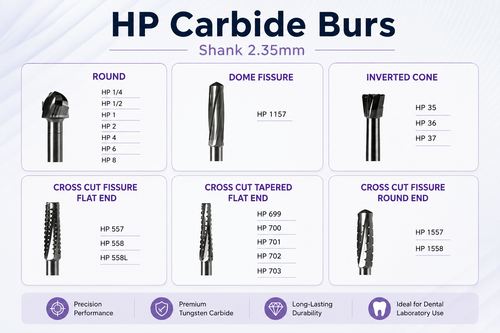
HP Carbide Burs
HP carbide burs are Laboratory carbide burs used mainly by dental labs and sometimes by dentists for trimming, contouring, cutting, polishing, and adjusting materials such as:
- Acrylic / PMMA
- Metal
- Resin
- Plaster
- Zirconia pre-sintered adjustments
- Denture materials
“HP” means:
HP = Handpiece
Specifically:
- HP shank diameter = 2.35 mm
- Used in:
- Laboratory straight handpieces
- Micromotors
- Low-speed lab motors
Pack of 10pcs
Difference Between Sizes
The size changes:
- Head diameter
- Head length
- Aggressiveness
- Precision
- Material removal speed
1. Round Bur — HP 1/4, 1/2, 1, 2, 4, 6, 8
Use:
- Drilling
- Access holes
- Removing material
- Internal adjustments
Difference:
Bigger number = bigger diameter.
| Code | Approx Diameter |
|---|---|
| HP 1/4 | Very tiny |
| HP 1 | Small |
| HP 4 | Medium |
| HP 8 | Large |
Large burs remove more material faster.
2. Inverted Cone — HP 35, 36, 37
Use:
- Undercuts
- Retention grooves
- Flat internal areas
Difference:
Usually:
- 35 = small
- 36 = medium
- 37 = larger
3. Cross Cut Fissure Flat End — HP 557, 558
Use:
- Fast acrylic cutting
- Crown adjustment
- Metal trimming
“Cross Cut” means:
Extra blades/notches for:
- Faster cutting
- Less clogging
- More aggressive cutting
Difference:
- 557 smaller
- 558 larger
- 558L = longer version
4. Tapered Flat End — HP 699–703
Use:
- Crown shaping
- Taper walls
- PMMA and acrylic contouring
Difference:
Higher number generally means larger diameter.
5. Round End Fissure — HP 1557, 1558
Use:
- Smooth internal cuts
- Rounded preparations
- Safer cutting without sharp corners


